VIN decoder
Enter a VIN to decode it for free: the year, make, model, trim and engine it identifies. The decoder reads modern 17-character VINs and the shorter VINs used before 1981. It shows what the vehicle is, not what happened to it.
What each part of a VIN means
A modern VIN has 17 characters in three parts. The letters I, O and Q are never used, so they can't be confused with 1 and 0. This example is a 1991 Honda.
- WMI (World Manufacturer Identifier), positions 1–3: 1HG
- VDS (Vehicle Descriptor Section, with the check digit), positions 4–9: BH41JX
- VIS (Vehicle Identifier Section), positions 10–17: MN109186
VIN positions
The layout is set for vehicles sold in the US by 49 CFR Part 565. Each maker decides what its codes in positions 4 to 8 mean.
| Position | Part | What it tells you |
|---|---|---|
| 1–3 | WMI | The maker and, in the first character, the region it is registered in. |
| 4–8 | VDS | The maker's codes for the vehicle: model line, body type, restraint system and engine, among others. |
| 9 | Check digit | A number or X calculated from the other 16 characters. It catches most typing errors. |
| 10 | Model year | A letter or digit for the model year (see the chart below). |
| 11 | Plant | The maker's code for the assembly plant. |
| 12–17 | Serial number | The vehicle's production number. |
First character: where the maker is registered
| First character | Region | Examples |
|---|---|---|
| 1–5 | North America | 1, 4, 5 = United States • 2 = Canada • 3 = Mexico |
| 6–7 | Oceania | 6 = Australia • 7 = New Zealand |
| 8–9 | South America | 8 = Argentina • 9 = Brazil |
| A–H | Africa | AA–AH = South Africa |
| J–R | Asia | J = Japan • KL–KR = South Korea • L = China |
| S–Z | Europe | S = United Kingdom • V = France or Spain • W = Germany |
VIN year chart: the 10th character
The 10th character gives the model year. The codes repeat every 30 years, so a W can mean 1998 or 2028: the rest of the VIN and the vehicle itself tell you which.
| 10th character | 1980 – 2009 | 2010 – 2039 |
|---|---|---|
| A | 1980 | 2010 |
| B | 1981 | 2011 |
| C | 1982 | 2012 |
| D | 1983 | 2013 |
| E | 1984 | 2014 |
| F | 1985 | 2015 |
| G | 1986 | 2016 |
| H | 1987 | 2017 |
| J | 1988 | 2018 |
| K | 1989 | 2019 |
| L | 1990 | 2020 |
| M | 1991 | 2021 |
| N | 1992 | 2022 |
| P | 1993 | 2023 |
| R | 1994 | 2024 |
| S | 1995 | 2025 |
| T | 1996 | 2026 |
| V | 1997 | 2027 |
| W | 1998 | 2028 |
| X | 1999 | 2029 |
| Y | 2000 | 2030 |
| 1 | 2001 | 2031 |
| 2 | 2002 | 2032 |
| 3 | 2003 | 2033 |
| 4 | 2004 | 2034 |
| 5 | 2005 | 2035 |
| 6 | 2006 | 2036 |
| 7 | 2007 | 2037 |
| 8 | 2008 | 2038 |
| 9 | 2009 | 2039 |
How the check digit works
You can check a VIN by hand. Worked example: 1HGBH41JXMN109186, whose 9th character is X.
Turn letters into numbers
A=1, B=2, C=3, D=4, E=5, F=6, G=7, H=8, J=1, K=2, L=3, M=4, N=5, P=7, R=9, S=2, T=3, U=4, V=5, W=6, X=7, Y=8, Z=9. Digits keep their value.
Multiply by the weights
Multiply positions 1 to 17 by 8, 7, 6, 5, 4, 3, 2, 10, 0, 9, 8, 7, 6, 5, 4, 3, 2. Position 9 has weight 0, so the check digit doesn't count itself.
Add and divide by 11
Add the 17 products and divide by 11. The remainder is the check digit; a remainder of 10 is written X. In the example the total is 340, and 340 ÷ 11 leaves 10, so the check digit is X.
Compare
If the result differs from the 9th character, the VIN was mistyped or altered. Check it against the dashboard, the door frame label and the title.
Pre-1981 VINs
The 17-character format applies to vehicles built for the US from the 1981 model year. Before that, each maker used its own format, from 5 to 17 characters, and the meaning of each position changed by maker, model and year. The decoder accepts these older VINs, but a decode is less complete than for a modern VIN, and some older numbers cannot be decoded at all.
For a classic, also see the classic car VIN check, which explains which records usually exist for older vehicles.
Where to find the VIN
Compare the VIN in two places on the vehicle and on its title. If they differ, stop and ask why before you rely on any decode or report.
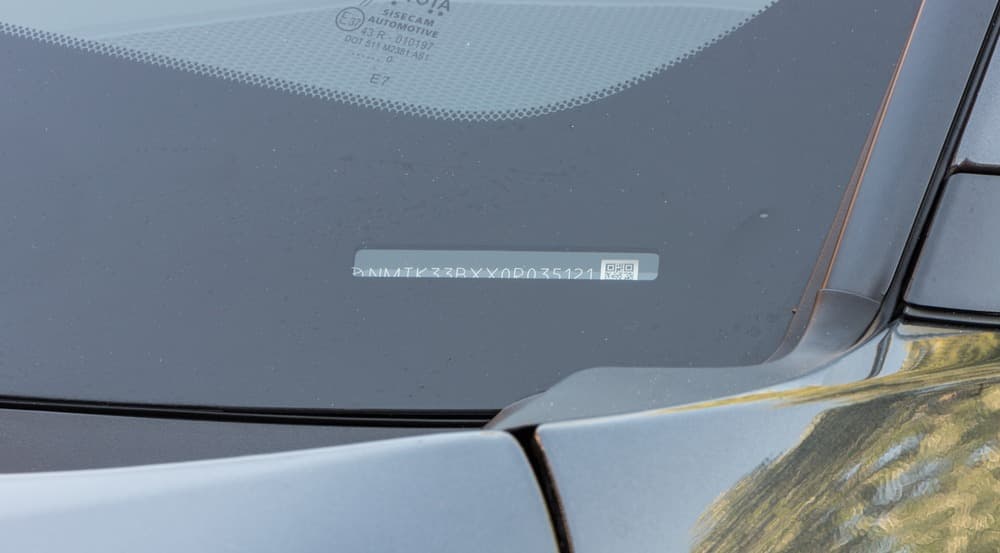
Dashboard
On most cars, at the bottom of the windshield on the driver's side, readable from outside.
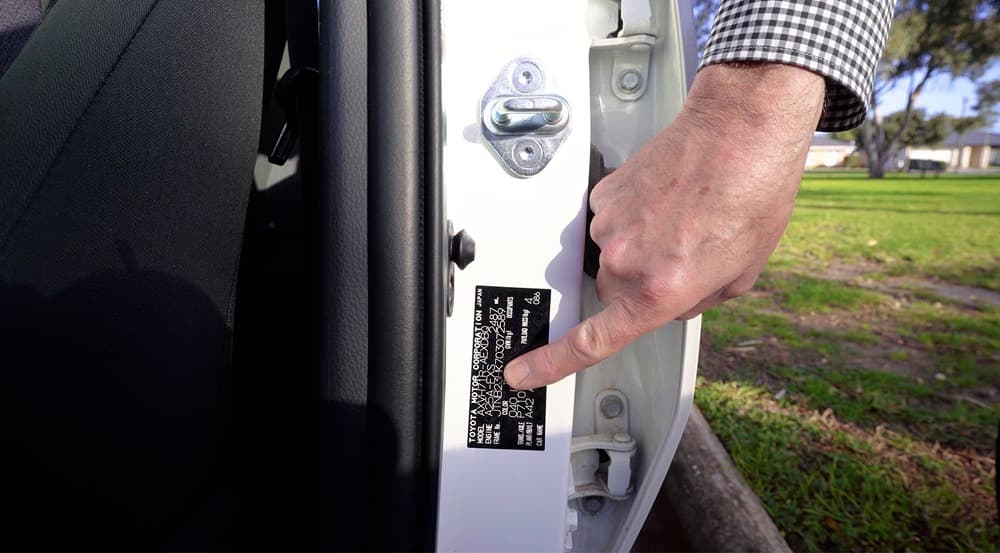
Driver's door frame
On the label in the door jamb, often the Federal Safety Certification Label.
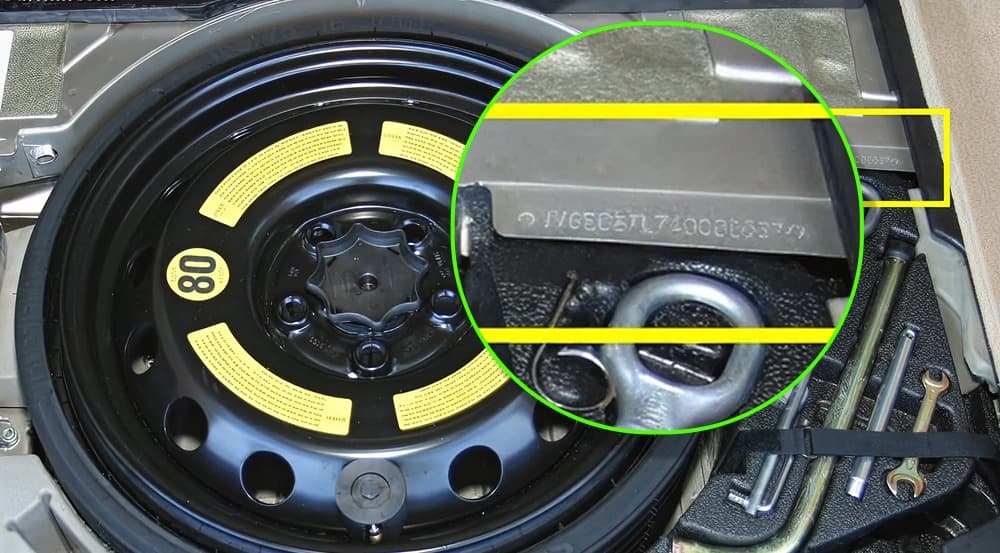
Under the spare tire
Some makers stamp the VIN in the trunk floor, under the spare tire.
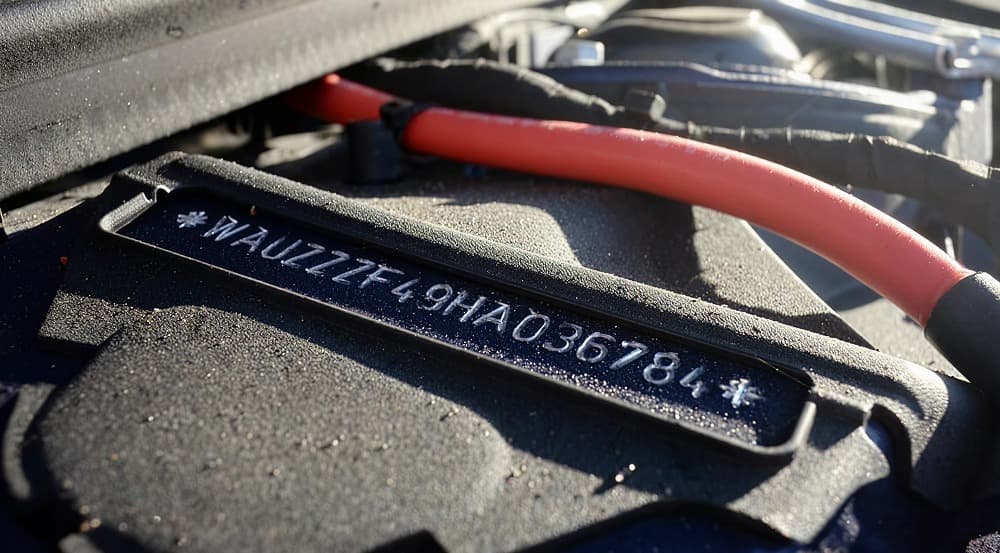
Frame and engine bay
On some vehicles it is stamped on the frame or in the engine bay. On motorcycles, look at the steering neck; on trailers, at the tongue.
What a decode can and cannot tell you
A decode reads the codes the maker put in the VIN. It describes the vehicle as built, from the VIN alone.
| Question | Decoder | Where to look instead |
|---|---|---|
| Which vehicle is this? | Yes: year, make, model, trim and engine | — |
| Is the VIN valid? | Partly: the check digit catches most typing errors | Compare the VIN on the vehicle and the title |
| Which options and packages did it have? | No, the VIN doesn't encode them | Window sticker data |
| Was it in an accident, branded or stolen? | No | Vehicle history report |
| Is the engine in it today the original? | No: it shows the engine the VIN was built with | An inspection |
VIN decoder questions
Is the VIN decoder free?
Yes. Decoding a VIN and seeing the year, make, model, trim and engine costs nothing. You pay only if you buy a history report or window sticker data.
How long is a VIN?
Vehicles built for the US from the 1981 model year have 17 characters. Older vehicles have 5 to 17, depending on the maker and year.
Why does my VIN not decode?
Check for typing errors first: the letters I, O and Q are never used in a modern VIN. If the check digit doesn't match, a character is wrong. Some older and specialty VINs can't be fully decoded.
Can a decoder tell me if the car was in an accident?
No. A decoder reads what the VIN encodes. Accidents, title brands and theft come from reported records, in the vehicle history report.
Can I find the paint color or options from the VIN?
Not from the VIN alone. Options, packages and colors are in the vehicle's window sticker data, where available.
Next step
See this vehicle's history
A decode tells you what the vehicle is. The history report shows the records reported for it since: title brands, accidents, theft, odometer readings and more.